
What To Know:
- Hong Kong’s financial industry supports compulsory CARF registration for crypto firms and financial institutions to meet OECD standards and protect market integrity.
- The association urges simplified registration for nil-reporting entities, clearer data privacy safeguards, and third-party options for record keeping after dissolution.
- Industry leaders recommend capped administrative penalties, API-based automated reporting, dual CARF–CRS reporting, and streamlined portal access for registered entities.
Hong Kong’s financial industry has voiced strong support for the mandatory registration of crypto asset service providers as the city prepares to implement the OECD’s Crypto-Asset Reporting Framework, commonly known as CARF.
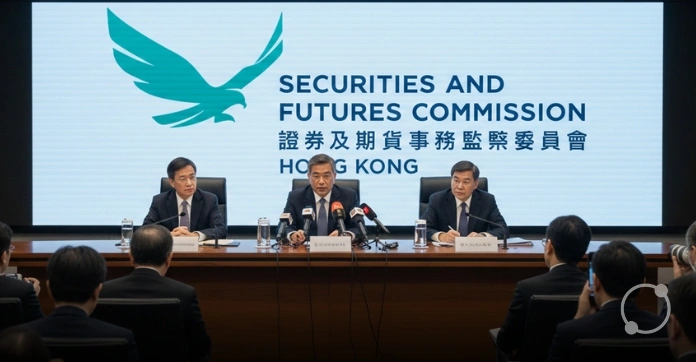
Hong Kong SFC Backs Mandatory Crypto Reporting
In a consultation response dated January 19, 2026, the Hong Kong Securities and Futures Professionals Association outlined on how the framework and related amendments to the Common Reporting Standard should be applied locally.
The association endorsed compulsory registration for reporting crypto-asset service providers and reporting financial institutions, arguing that such measures are necessary to meet OECD expectations and maintain confidence in Hong Kong’s regulatory system. It noted that mandatory registration would allow authorities to identify the full population of entities operating in the crypto space. This would prevent compliant firms from being undercut by unregulated competitors.
At the same time, the group urged regulators to adopt a more proportionate approach for entities with no reportable transactions. For firms that anticipate filing nil returns, it proposed a simplified or “lite” registration process that would reduce administrative costs without weakening oversight.
The consultation response also addressed how data should be collected under CARF. Industry participants generally support a wider approach that involves gathering information on both reportable and non-reportable clients at onboarding. According to the association, attempting to classify clients only at the initial stage creates long-term monitoring burdens, particularly when clients move jurisdictions or when reporting lists are updated.
However, the group emphasized that legal clarity is required to ensure such data collection does not conflict with Hong Kong’s Personal Data (Privacy) Ordinance. Explicit safeguards, it said, are needed to protect institutions that collect information in anticipation of future reporting obligations.
Record-keeping requirements were another area of concern. Notably, the proposed six-year retention period aligns with existing inland revenue and CRS standards. But, the association raised objections to placing long-term liability on directors or officers after an entity has been dissolved. It warned that former officers may lack the infrastructure or legal authority to securely store sensitive client data.
Instead, it recommended allowing licensed third-party custodians, such as liquidators or corporate service providers, to assume record-retention duties once an entity stops operations.
On enforcement, the association supported the introduction of an administrative penalty regime rather than criminal prosecution. It described administrative penalties as a faster and more practical method of resolving non-compliance. Still, it cautioned against applying uncapped “per account” fines for minor technical breaches. The warnings were particularly around cases when software errors affect large numbers of users.
Without reasonable limits, it warned, penalties could escalate to disproportionate levels even in cases where no intent to evade reporting exists. The group proposed the introduction of penalty caps for unintentional or first-time errors. The group also aims to reserve harsher treatment for cases involving willful misconduct.
The industry body also addressed the technical mechanics of CARF reporting. While it welcomed electronic filing, it called on authorities to provide an application programming interface alongside XML uploads. For large crypto institutions, direct API connectivity is seen as essential for automated reporting and risk reduction.
The proposed five-month filing deadline after year-end was described as challenging given the complexity of crypto transaction data. The association recommended a grace period during the first two years of implementation to allow systems and processes to stabilize.
Views were similarly pragmatic on reporting standards. The association expressed strong support for a default dual-reporting arrangement under both CARF and CRS. Even though this approach may involve duplication, it reduces reconciliation complexity and lowers the risk of under-reporting caused by system mismatches. Aligning with the global default model, it said, would also help multinational institutions operate under a consistent reporting structure.
Mandatory registration for all reporting financial institutions was also accepted in principle. However, the association urged regulators to simplify CRS registration for entities already registered under CARF or holding valid business registration numbers. It proposed a single portal system using tick-box activation rather than multiple standalone applications.
Concerns were also raised about the requirement for individual digital certificates for every entity, particularly for fund managers controlling hundreds of investment vehicles. For this purpose, a service-provider level authentication model was suggested as a more workable alternative.
Also Read: India Pushes BRICS Digital Currency to Ease Cross-Border Payments