
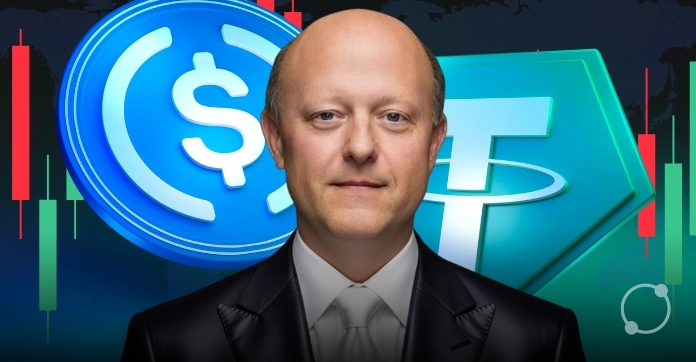
Circle CEO Jeremy Allaire has rejected claims surrounding the potential risks of stablecoin interest payments to the traditional banking system. During the World Economic Forum in Davos, Allaire asserted that such concerns are exaggerated and do not reflect the reality of stablecoin rewards.
Dismissing these concerns as “totally absurd,” the Circle CEO claimed that the stablecoin yields do not pose threats to banks. He also added that the stablecoin proposals under the CLARITY do not undermine the US monetary policy.
Circle CEO Dismisses Stablecoin Yield’s Bank Risk Concerns
According to the latest reports, Circle CEO Jeremy Allaire raised his voice against the ongoing discussions against the stablecoin provision of the CLARITY Act. Speaking at the World Economic Forum in Davos, Allaire dismissed claims that the stablecoin rewards program could harm banks.
“They help with stickiness, they help with customer traction,” stated the Circle head. He added that such reward-based financial services already exist and have been successfully running for many years.
Adding more points to his argument, he referred to the government money market funds. Comparing stablecoins to these funds, he stated that previously, when the money market fund was launched, many had raised concerns about its negative impact on banking institutions. But without disrupting the banking space, these funds have now grown to a massive $11 trillion market. He added,
“Meanwhile, lending is already shifting away from banks toward private credit and capital markets. In the US, much of GDP growth over multiple cycles has been funded through capital-market debt, not bank loans. We want to build models for lending that build on top of stablecoins.”
Stablecoin Rules Spark Debate Under CLARITY Act
The US CLARITY Act has reignited a heated debate within the crypto industry over how stablecoins should be regulated, especially based on yield generation. Lawmakers backing tighter regulations argue that limiting yields is necessary to protect the banking system. They argue that if stablecoin rewards are largely promoted, it could see massive outflows from the traditional financial ecosystem.
However, industry experts like the Circle CEO argue that these concerns are overstated. They warn that overly strict provisions could slow innovation. Other industry players like Coinbase CEO Brian Armstrong have also raised concerns, pointing out the limitations. He is concerned that the bill is too restrictive, effectively limiting who is allowed to offer dollar-based rewards on-chain. He states that the bill favours banks and custodians, sidelining crypto platforms.
Expressing his strong opposition, Armstrong withdrew support for the market structure bill. He stated, “No bill than a bad bill.”
AI Could Accelerate Stablecoin Adoption, Says Circle CEO
Further, the Circle CEO stated that artificial intelligence (AI) could drive wider use of stablecoins. He added that billions of AI agents will potentially seek a reliable way for payments, which makes stablecoin a viable option.
Similar views were also shared by other industry experts like Binance founder Changpeng Zhao (CZ) and Galaxy Digital CEO Michael Novogratz. While CZ stated that stablecoins could play a key role in transactions driven by AI, Novogratz posited that AI agents are poised to become the largest users of stablecoins.