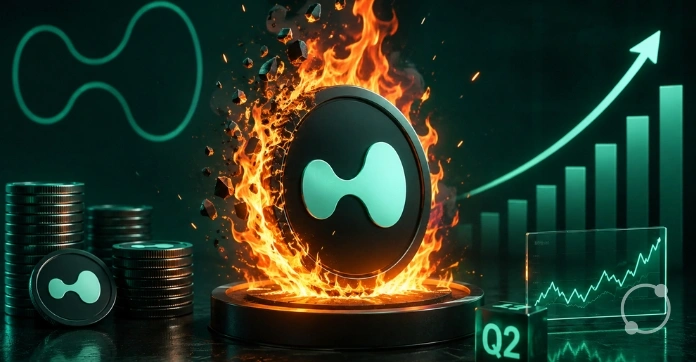
As per Onchain Lens data posted on X today, August 6, 2026, Hyperliquid has burned approximately 1.28 million worth of $HYPE in the last 24-hours. Moreover, it has also generated about $1.6 million fees. This burn brings the total HYPE removed from circulation to 47.53 million tokens, priced at $2.68 billion, which is 4.7% of the HYPE’s total token supply. The burn comes amidst the Q2 report focusing fee-driven supply reduction as one of its core strengths..
What Is the Factor Behind the HYPE Burn?
Hyperliquid’s token destruction adjoins the trading platform activity to HYPE’s supply. Fees generated by the protocol are used to purchase HYPE from the market. After the purchase, the tokens are destroyed, distinct from a normal treasury purchase. Burned tokens cannot be sold or used for circulation, which reduces the maximum available supply during the tenure. The newest reporting window demonstrates the connection between usage and supply reduction.
Hyperliquid generated approximately $1.65 million in fees and burned around $1.28 million in HYPE. While the value can differ from the fees generated due to the factors of time, price, and the execution of buybacks, the comprehensive model is created to make platform activity the source of HYPE demand. The predicted numbers are becoming crucial, with 47.53 million HYPE burned, equivalent to nearly one in every 20 tokens in the maximum supply.
The outcome is a token economy in which trading activity affects supply, rather than boost a protocol treasury. This nuance is a core element in the 2026 Hyperliquid Q2 quarterly report written by Four Pillars and GLC Research. The report states that Hyperliquid’s newest growth is starting to shift into a better economic and positive outlook . This represents trading that generates more fees. Fees support HYPE buybacks, and buybacks affect and decrease the token supply.
Why Q2 Report Matters for Hyperliquid?
As per the Q2 report, the coin burn context arrived, in which Hyperliquid extended beyond crypto-centric trading. Contracts linked to equities, commodities, and pre-IPO companies through HIP3 accounted for $213 billion in quarterly gains, rising from 1.8% of matched volume in the starting period, to 32.2% in Q2. The report serves as proof that real-time asset markets are starting to step up in the niche.
Market data demonstrated the RWA segment consisting of more than half of Hyperliquid’s weekly volume in the month of July. This is to note that quarterly figures and weekly figures measure different periods. The change is crucial as it depicts how Hyperliquid is trying to become more than a place for crypto perpetuals. It is placing itself as an on-chain market for equities, commodities, and other financial exposures.
The Q2 report indicated that HYPE price rose 79% during this quarter to a record price of $76.90. Simultaneously, Bitcoin declined by 14%. Protocol revenue recovered from an April low, reaching its strongest monthly level since November, closing the quarter at $169 million, as per the report. It further mentioned that $141 million was returned to the stakeholders through buybacks, while cumulative revenue surpassed $1 billion.
The information also emphasized the first three HYPE exchange-traded funds starting to trade in the United States. Hyperliquid Strategies were witnessed to hold 29.3 million HYPE, while the assistance fund and treasury bodies together held 7.7%.
Final Thoughts
Hyperliquid’s burn is notable because it demonstrates how the platform is trying to link real usage with HYPE’s long-term tokenomics. The Onchain Lens data so provided depicted $1.28 million token burn and $1.65 million in fees. This reinstates the trading activity’s role in decreasing supply.
On the other hand, the Q2 report indicates that the model is strengthening as Hyperliquid diversifies into real-world assets and increases protocol revenue. The key question comes down to whether the fee and burn positive feedback loop can remain stable if the market faces ups and downs.