
What To Know:
Berachain’s 10x Faster Transaction Proposal Pushes BERA Up 0.7%
The proposal discusses a major upgrade focused on performance, fairness, and reliability. Built on Berachain’s own Beacon-Kit consensus client and Bera-Reth execution client, the system requires no additional components for validators. It is designed to improve user experience for time-sensitive apps like DeFi trading, gaming, and other high-frequency use cases, where even a slightest delay can be an issue.
According to Berachain’s developers, this upgrade will deliver near-instant transaction confirmations. For users, that would mean seeing transactions included on the chain in under a second, instead of waiting for two seconds for confirmation. The improvement could bring blockchain UX closer to the seamless speed of Web2 platforms, while preserving decentralization and security.
One of the most notable features of the proposal is that it’s opt-in i.e., applications and validators can choose whether to participate in pre-confirmations or continue using the traditional 2-second finality window. This makes sure that developers handling reorg-sensitive or high-value transactions can stick with standard confirmation times, while others can take advantage of faster inclusion.
Even if the preconfirmation module were to face an issue, the chain would continue operating normally. That safety feature underscores Berachain’s intent to deliver speed without compromising stability.
The technical side of the proposal goes deep into how the system integrates with Berachain’s existing architecture. In this design, the sequencer’s execution layer does not directly verify who the next proposer is. Instead, this task is delegated to Beacon-Kit, which checks and validates whether the next proposer belongs to the preconfirmation network before triggering the payload-building process.
Once a proposer is confirmed, Beacon-Kit fetches payloads from the sequencer and validates them locally using the Bera-Reth client. This dual validation ensures that no unverified or invalid data enters the chain. If the sequencer goes out of sync, delivers an invalid block, or fails to respond in time, a process called fallback building kicks in. In such cases, Beacon-Kit takes over block production independently, avoiding system downtime.
While fallback building is a reliable backup, the team notes that it can cause temporary reorganizations within the network, which are ideally avoided. The proposal also mentions a brief gap between the stages of PrepareProposal and ProcessProposal, during which no pre-confirmations occur. Future optimizations, the developers say, could minimize this interval when consecutive proposers participate in the preconfirmation network.
The proposal discusses potential risks such as a sequencer private key leak, which could allow a malicious actor to trick RPC nodes into serving unstable or incorrect state data. In such cases, nodes would need to update configurations to the new sequencer key.
Berachain plans to roll out the preconfirmation system in phases. The first phase will involve select validators opting in, helping with pre-confirmed state data only through dedicated RPC endpoints. The second phase expands participation to more validators, still using specialized RPC nodes. In the third and final phase, most validators will join the network.This will allow preconfirmed data to be accessed through standard RPC endpoints across the ecosystem.
This phased approach will let the team closely observe the network’s performance and resilience before a full-scale rollout. It also ensures validators can test, adjust, and optimize configurations without risking network stability.
The Preconfirmation System, if worked out as planned, could make Berachain one of the fastest Layer 1 blockchains currently in development. It combines low latency and fair transaction ordering with a flexible, modular design. For developers building high-frequency trading systems, blockchain games, or any application where instant feedback matters, this could be game-changing.
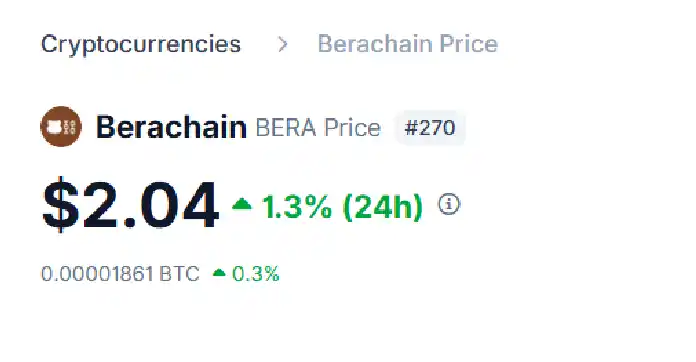
After this move gained attention, BERA, which is racing to be one of the top cryptos to buy at the moment, rose 0.7% in the past 1 hour and 1.3% in the past 24 hours.
Also Read: Dogecoin (DOGE) Struggles & Slides 8% as Market Turmoil Deepens