
What To Know
- Chainlink consolidates in a symmetrical triangle, signaling potential breakout ahead.
- $25 breakout could push LINK swiftly toward $30 target, analysts suggest
- Failure to hold range may drag LINK toward $19–$15 support zones.
Chainlink (LINK) investors are now once again in a tough spot as the token’s weekly and daily charts have turned red. This clearly suggested that bears were leading the market, which indicated that the chances of a continued price decline are high. But, the reality might be different. LINK might be moving inside a pattern, which might have cased this short-term correction. Ergo, let’s try to find out what is actually happening.
Chainlink’s Symmetrical Pattern
Anxiety has gripped the market after Chainlink shed almost 6% on a weekly basis and had given away an extra 3% in the span of 24 hours. At the time of writing, LINK is changing hands at $23.53, reflecting the bearish pressure. LINK had even witnessed relatively subdued market activity, as its average daily volume dropped 15%.
At the giving-at-surface sort of comment that maybe…market analysts believe this correction phase might lead to a bullish formation. One of the prominent crypto analysts, Ali Martinez, recently stated on X that LINK is consolidating inside a symmetrical triangle pattern from where a massive breakout could occur.
Breaking $25 puts Chainlink $LINK on track for $30! pic.twitter.com/5DCNMLQ2dw
— Ali (@ali_charts) September 19, 2025
For the unversed, the symmetrical triangle is a chart pattern generated whenever price sets a series of lower highs and higher lows coming into a narrowing range. Such price action tends to indicate indecision amongst traders but also signals brewing volatility. Historically, break-outs through symmetrical triangles has considered it a continuation pattern, meaning that once out of it, price prefers to move with the larger trend. Since LINK has been in a broader bullish phase lately, hence this consolidation can very well be a healthy pause before a bigger upward run.
According to Martinez, $25 is a key resistance to track. If LINK was to break over this level, the momentum might see a very swift turn prevailing towards the bulls. Thus, he said that the eyes should be set on $30 by investors as a major target of resumption and on further bullish momentum by LINK. Until then, LINK’s movement inside the symmetrical triangle will keep traders on tenterhooks while the token consolidates and builds pressure for its next step.
What LINK’s Daily Chart Suggests
Adding further technical perspective, an independent analysis rendered by CryptoMoonPress indicates that LINK moves in consonance with a parallel channel-a price formation that typically aids traders to identify important support and resistance zones. Taking this in alignment with the symmetrical triangle above-mentioned by Ali Martinez, the parallel channel gives somewhat clear hints as to the targets from a bullish or bearish perspective.
If the triangle stays intact and LINK breaks through the $25 resistance level, the channel would be indicating the $30 mark as the next plausible target-from a bullish perspective-thirdly corroborating Martinez’s view. A move to this area would again affirm LINK’s longer-term bullish trajectory as well as uplift the investor sentiment, which may have crumbled down a bit lately amid the short-term corrections.
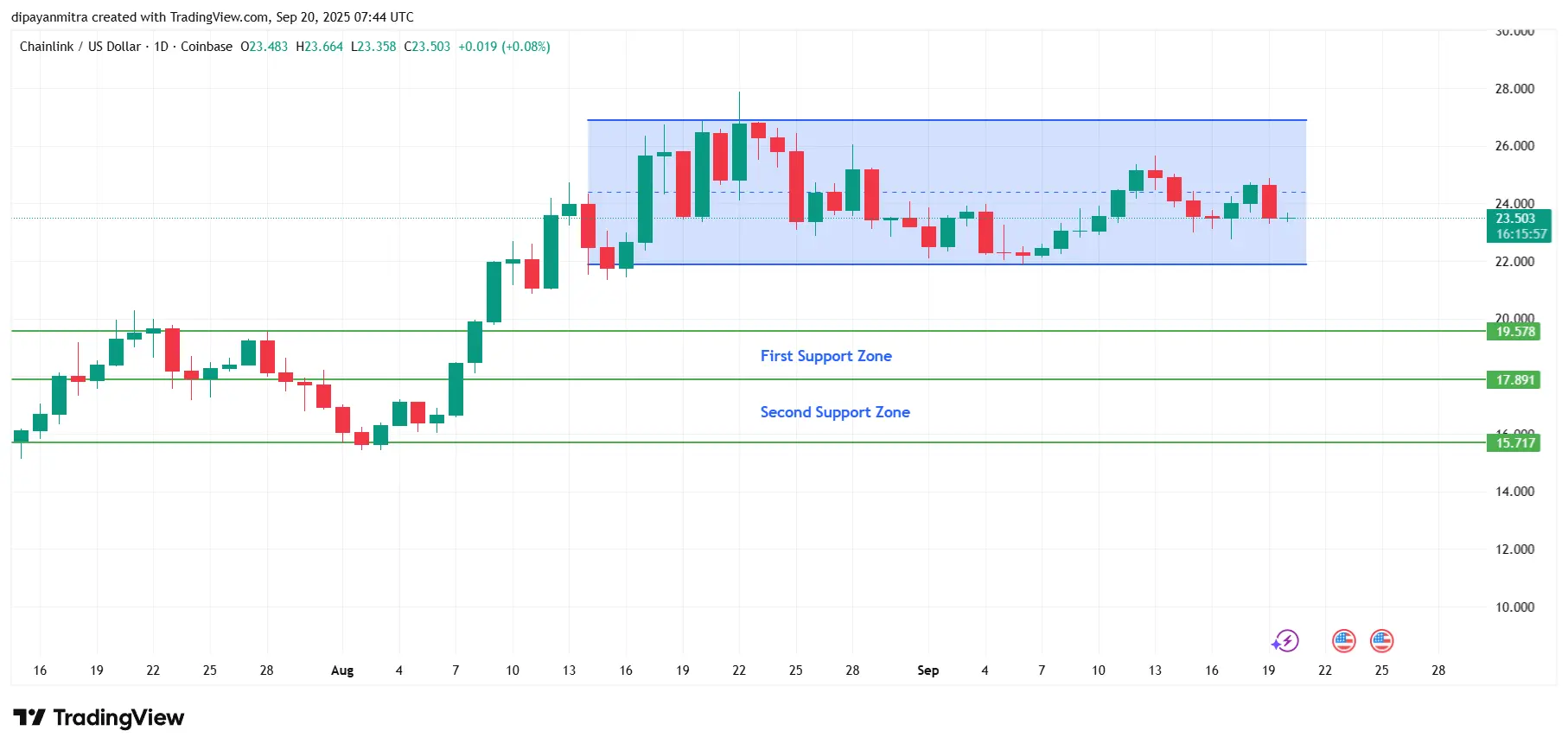
However, the analysis also identified the risks if LINK fails to defend against its current range. An initial strong support is found between $19 and $17 on the bearish side, given that historical buying interest had cushioned drops inside that zone. Increased bearish pressures below the support level would bring more severe corrections worse than what currently faces LINK, with the next cluster of support being between $17 and $15. Such a move would put the bulls on the defensive, rebuilding momentum before attempting another rally. In simple terms, LINK’s current holding within both the triangle and the channel lays the groundwork for a decisive move, either up to $30 or down to critical support zones.