What To Know:
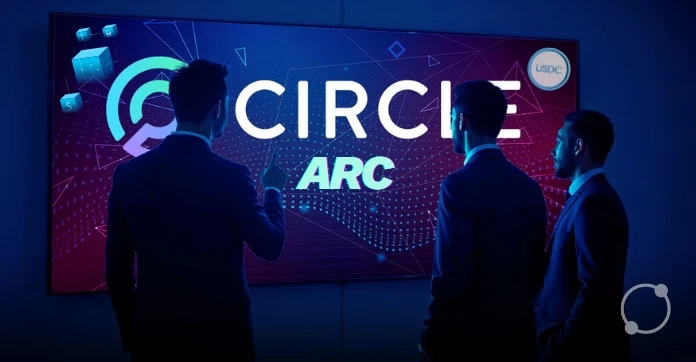
- Circle has launched the public testnet of Arc, a new Layer 1 blockchain designed to bring global finance on-chain with predictable fees and fast transactions.
- The initiative has drawn over 100 major participants, including BlackRock, Goldman Sachs, HSBC, and Deutsche Bank, exploring tokenized assets and cross-border liquidity.
- Arc integrates with Circle’s USDC and payments stack, connecting exchanges, custodians, and DeFi protocols like Uniswap, Aave, and Curve.
The stablecoin firm, Circle, has launched the public testnet of its new blockchain network, Arc. The open Layer 1 network is designed as a base for global finance to operate natively on the internet. The launch brings together participation from more than one hundred major companies across banking, payments, technology, and asset management.
Circle Launches Arc Public Testnet
The testnet marks a major milestone for Circle, which describes Arc as an “Economic Operating System” for the internet. As per the official release, the network promises predictable dollar-based fees, sub-second transaction finality, and configurable privacy options. It also connects directly with Circle’s existing infrastructure, including its stablecoin and payments technology stack.
Circle’s new initiative has drawn interest from some of the largest names in global finance. Participants include BlackRock, Goldman Sachs, HSBC, Deutsche Bank, Standard Chartered, Société Générale, and State Street. These firms are exploring how Arc can support tokenized assets, on-chain settlement, and cross-border liquidity.
Jeremy Allaire, CEO of Circle, said that Arc’s public testnet is already showing strong momentum, with leading institutions beginning to build and test on it. He added that the project is designed to connect local economies globally and create a more open and efficient financial system.
Arc has attracted a diverse range of contributors, from exchanges and custodians to developer platforms and AI tools. Blockchain infrastructure providers such as Alchemy, LayerZero, and QuickNode are integrating with Arc to support developers. Custody providers including BitGo, Copper, and Zodia Custody will bring institutional-grade security to on-chain assets.
Major crypto exchanges like Coinbase, Kraken, Robinhood, and Bybit are participating to expand access to Arc’s network. On the decentralized side, protocols such as Uniswap, Aave, and Curve are exploring liquidity and yield options within the ecosystem.
Arc also provides a base layer for stablecoin and asset issuance, including gas fees and FX liquidity. Stablecoin issuers from several regions, such as JPYC in Japan, BRLA in Brazil, MXNB in Mexico, and PHPC in the Philippines, have already joined the testnet.
The testnet launch places a strong focus on developer access. Arc connects with leading digital wallets such as MetaMask, Fireblocks, and Ledger, allowing teams to build and test applications across desktop and mobile. AI tools based on Anthropic’s Claude SDK will assist developers in building smart contracts and testing network functions.
Circle envisions Arc as a shared, neutral layer of infrastructure for the global economy. The company plans for the network to eventually transition to distributed governance, involving validator participation and community-led decision-making.
While Circle is currently leading the development phase, the long-term goal is for Arc to become a community-operated network governed by financial institutions, technology companies, and developers.
Many institutions see Arc as a link between traditional and digital finance. The scale of institutional participation reflects growing interest in blockchain networks that meet enterprise-grade standards.
Robert Mitchnick, Global Head of Digital Assets at BlackRock, said the company aims to understand how stablecoin-based settlement could improve capital market efficiency.
Payment companies such as Visa and Mastercard are also involved, expanding their collaboration with Circle to test faster, programmable payment systems.
As for Circle, USDC, the stablecoin has taken even the central bank’s ecosystem by storm, thanks to its fast, low-cost global transactions.
Just recently, Europe’s ClearBank also signed a framework deal with Circle Internet Financial to expand USDC and EURC in Europe and deliver faster and cheaper cross-border transfers.
Also Read: Japan’s Megabanks to Launch Yen & Dollar-Backed Stablecoins