
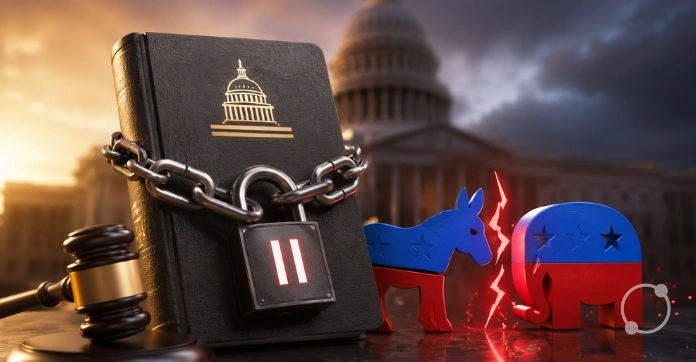
The Digital Asset Market CLARITY Act is officially on hold after hitting a sudden political roadblock in the U.S. Senate. This bill represents an attempt by federal lawmakers to establish clear regulatory boundaries for digital currencies.
Designed to split market oversight clearly between the Securities and Exchange Commission (SEC) and the Commodity Futures Trading Commission (CFTC), the legislation aims to give digital assets a predictable regulatory home while setting concrete rules for stablecoin issuers. After passing the House of Representatives with an overwhelming bipartisan majority, the bill seemed positioned for a historic vote on the Senate floor.
However, an unexpected last-minute legislative freeze has effectively killed any chance of the bill passing before the upcoming August congressional recess. With the Senate prioritizing a bipartisan Russia sanctions package and other high-priority legislative business (nominations and government funding measures), lawmakers, institutional investors, and digital asset firms must now wait until at least late September for a vote.
How Political Fighting Put This Bill On Hold
This sudden legislative freeze came after intense political fighting over a newly added government ethics provision. The provision, which has been backed by the White House and since it has been added to the new draft of the bill through last-minute negotiations; the controversial measure aimed to impose new restrictions on senior federal officials and their spouses over certain cryptocurrency-related activities to address conflict-of-interest concerns.
According to reports, key Senate Democrats quickly halted progress on the bill over the new rules. They argued that the federal ban overreached and inadvertently weakened existing state-level consumer protections by handing too much centralized authority to federal agencies. This rapid fracture in consensus completely shattered what had been a remarkably resilient bipartisan coalition, flipping the legislative timeline on its head overnight.
Seeing the growing division, Senate Majority Leader John Thune chose to remove the Clarity Act bill from the immediate voting schedule altogether, pivoting instead to prioritize non-controversial legislation before everyone packs up for the summer recess.
This unexpected delay sent immediate shockwaves through political prediction markets. On platforms like Polymarket, the estimated odds of the bill passing before the end of the year plummeted from a highly confident 80% down to a meager 37% in just a matter of hours.
Despite all this, financial giants like Franklin Templeton are continuing to publicly champion the bill, emphasizing that a clear statutory framework is absolutely vital for the long-term stability of the American financial system. Industry trade groups and Republican lawmakers are already pushing to iron out the ethics dispute the second Congress reconvenes in September, though finding a real compromise will mean going back to the drawing board to rewrite the contentious text.
How Government Action Caused Major Market Damage
This legislative hold has sent shockwaves through the entire crypto ecosystem, damaging everyday retail prices and completely messing up long-term corporate plans. The moment word got out that the bill was being shelved, the crypto market took a shocking dive. As highlighted by market analysts Crypto Rover, Bitcoin rapidly broke below $65,000, while Ethereum went down by more than 4% as traders closed out their bets on a quick fix.
This sharp drop is a direct result of traders realizing that a quick “regulatory win” isn’t happening anytime soon. Because of this sudden delay, traditional financial giants are putting a stop to their blockchain integration plans, simply because they aren’t willing to risk massive amounts of capital under temporary, makeshift rules.
Instead of getting a safe, straightforward federal registry to work with, exchanges are still trapped in a frustrating, expensive loop of defending themselves against ongoing government lawsuits. When you look at the bigger picture, this unexpected gridlock just drags out a painful culture of compliance confusion, leaving American crypto businesses with absolutely no choice but to wait out the summer and wait for a real legislative breakthrough in late September.