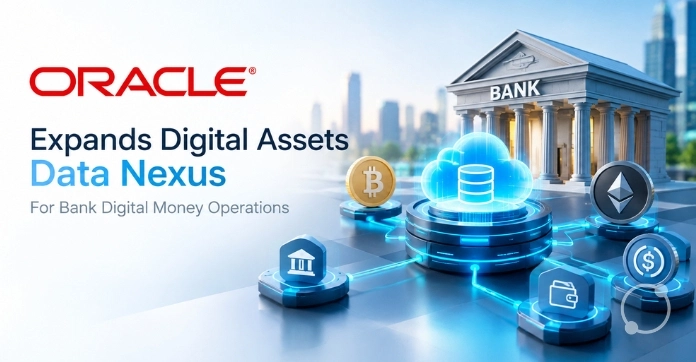
Oracle is expanding its Digital Assets Data Nexus platform with new payment integrations, wallet and smart-contract controls, and AI-assisted transaction monitoring aimed at helping banks handle digital forms of money alongside existing payment systems.
The September 23 announcement adds support for ISO 20022 payment operations, a prebuilt connection with Oracle Banking Payments and integration with Swift Ledger. The platform is designed to support tokenized deposits, stablecoins, central bank digital currencies and other digital assets while keeping payment, compliance and settlement processes within existing banking infrastructure.
Oracle said the expanded system is planned for fiscal 2027, so the announcement describes capabilities that are being developed rather than confirming a broad rollout across banks. The update builds on Digital Assets Data Nexus, which Oracle first introduced in 2025 as an infrastructure platform for financial institutions working with blockchain-based assets.
Oracle Connects Digital-Money Transactions With Existing Payment Systems
The main part of the update is Oracle’s effort to connect digital-money transactions with payment infrastructure banks already use. The company said Digital Assets Data Nexus will integrate with ISO 20022-based payment hubs, allowing payment instructions, customer information and accounts to be mapped to digital wallets and digital-money rails.
The platform is designed to coordinate on-chain and off-chain activity while returning payment status, account reporting and transaction notifications to existing payment hubs. This means banks would not necessarily need to establish a separate payment stack for every digital asset or blockchain network.
Reports also stated that the expanded system will support tokenized deposits, stablecoins and CBDCs through existing ISO 20022 payment systems. Reports also noted that Oracle Banking Payments customers will receive a prebuilt integration with Digital Assets Data Nexus.
Oracle is also adding support for Swift Ledger. The company said the integration can synchronize interbank payment commitments and transaction states within a bank’s tokenized-deposit environment with Swift Ledger. It can then trigger workflows involving custodial wallets and existing bank payment systems, with final settlement handled through real-time gross settlement or correspondent-banking networks.
The development comes as financial institutions continue working on ways to connect blockchain-based transactions with traditional settlement infrastructure. Reports stated that on September 21 that the European Central Bank had launched Pontes, a service linking its payment system with blockchain-based financial markets.The ECB said the system is intended to allow blockchain transactions to settle using central bank money.
Oracle’s current announcement builds on a platform first introduced in October 2025. At that time, Oracle described Digital Assets Data Nexus as a system designed to help financial institutions issue and manage blockchain-based digital assets.
The original platform included multi-ledger infrastructure, tokenization smart contracts, workflow automation and data-governance features. The latest update therefore adds payment execution and operational controls to an existing Oracle product rather than introducing Digital Assets Data Nexus for the first time.
New Controls Add Compliance And AI-Based Transaction Monitoring
Oracle is also expanding the platform’s controls around digital-money transactions. According to the company’s announcement, Digital Assets Data Nexus can integrate KYC and KYB checks, sanctions and anti-money-laundering screening, wallet authorization policies, transfer limits and approval requirements into transaction workflows. These controls are intended to address some of the operational differences between blockchain transactions and conventional banking payments.
Oracle said digital-money transactions can operate continuously and may become technically irreversible soon after execution, reducing the time available to detect unauthorized activity or correct operational errors.
The platform will bring transaction and ledger history, wallet-policy evaluations, workflow records and smart-contract state into Oracle AI Database. Oracle said this can support reconciliation, audit trails, anomaly detection, fraud-pattern analysis, investigations and regulatory reporting.
Moreover, the expanded platform will use Oracle AI Database to analyze transaction anomalies, liquidity pressures, fraud risks and potential anti-money-laundering issues. The system can also support controlled responses such as changing transaction limits, suspending accounts or freezing token activity.
Oracle said the AI Database can also support behavioral and graph analytics, vector-based similarity searches and natural-language queries. These tools are intended to help banks identify relationships between transactions and potentially suspicious activity across different data types.
The company has also positioned the system around interoperability between different digital-money networks. The announcement mentions tokenized deposits, stablecoins, CBDCs, digital bonds, funds and other real-world assets, alongside emerging banking interoperability models such as Commercial Bank Money Token and Swift Ledger.
However, the announcement does not identify a bank currently using these newly expanded payment-execution and smart-contract capabilities in production. Oracle says the expanded Digital Assets Data Nexus is planned to be available in fiscal 2027. Its release also includes a future-product disclaimer stating that development, release timing and functionality may change.
The current announcement therefore provides details about Oracle’s planned banking infrastructure rather than establishing that the expanded system has already been adopted broadly by financial institutions.