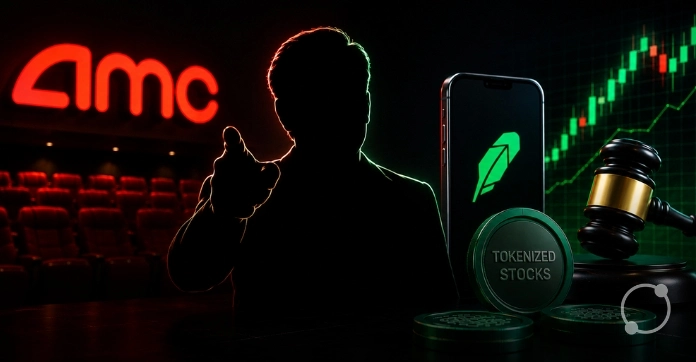
AMC Entertainment CEO Adam Aron has publicly criticized Robinhood over tokenized products linked to AMC shares, questioning how the offering can be legal and saying the theater company has no connection to or involvement in it. Aron said AMC would have its outside securities counsel examine the matter. Robinhood’s own disclosure states that its Stock Tokens are tokenized debt securities issued by Robinhood Assets (Jersey) Limited and provide economic exposure to the underlying securities without conferring on holders legal or beneficial rights in those securities.
The disclosure also states that the tokens are not registered under U.S. securities laws and cannot be offered, sold, or delivered in the United States or to U.S. persons. The dispute leaves open questions about how these products are structured, what rights token holders receive, and how securities rules apply to their distribution.
AMC Questions Robinhood’s Tokenized Stock Offering
Aron’s criticism centers on Robinhood’s Stock Tokens, which the company says provide economic exposure to more than 190 stocks and exchange-traded funds. AMC is among the companies referenced by the products. Aron said AMC had no connection to the initiative and did not authorize or endorse the Stock Token linked to its shares. He said AMC would immediately have outside securities counsel look into the matter. Decrypt reported on Aron’s comments, including his decision to have legal counsel examine the offering.
Robinhood apparently is behind an effort related to “tokenized real-world assets including Stock Tokens” for AMC Entertainment (and supposedly 190+ other companies). They are not registered under U.S. securities laws !!!!!!
I find this practice to be contemptible, outrageous,…
— Adam Aron (@CEOAdam) September 3, 2026
The document Aron attached to his post provides more detail about Robinhood’s structure. Robinhood’s Stock Token disclosure identifies Robinhood Assets (Jersey) Limited as the issuer and says the Stock Tokens are tokenized debt securities. The disclosure states that the tokens provide economic exposure to the underlying securities but do not grant investors legal or beneficial rights in those securities. Robinhood’s disclosure also states that the Stock Tokens have not been registered under the U.S. Securities Act and cannot be offered, sold, or delivered, directly or indirectly, in the United States or to U.S. persons. It lists additional restrictions in other jurisdictions and identifies Robinhood Assets (Jersey) Limited as a private company incorporated in Jersey.
The distinction between registration and availability is important to the dispute. Aron’s post questions how the arrangement can be legal and objects to AMC’s stock being represented without the company’s involvement. But Robinhood’s disclosure also explicitly says the products cannot be offered to U.S. persons. The fact that a product is not registered under U.S. securities laws therefore should not, on its own, be presented as proof that Robinhood is illegally offering it in the United States.
The issue has attracted attention because the products allow users to gain financial exposure to stocks without purchasing the underlying shares directly. CoinDesk’s report on Aron’s criticism described the dispute as raising questions about how stocks are represented through tokenized instruments. AMC has not been described as a participant in creating or issuing the Stock Token. Instead, the product is issued through Robinhood’s Jersey entity, which is separate from the company whose stock the token references.
Robinhood’s Stock Tokens Separate Price Exposure From Share Ownership
The dispute partly comes down to what a Stock Token represents. Robinhood’s Stock Token information describes the products as tokenized debt securities that provide economic exposure to an underlying security without giving holders legal or beneficial rights in that security. That means a person holding an AMC Stock Token does not simply own an AMC share in digital form. A conventional AMC shareholder holds the underlying security and its associated shareholder rights. A Stock Token holder instead holds a separate financial instrument issued through Robinhood Assets (Jersey) Limited.
Robinhood said that when it expanded its tokenized-asset offering, Stock Tokens were intended to give eligible customers outside the United States economic exposure to U.S. stocks and ETFs. The company said its offering covered more than 190 stocks and ETFs. Robinhood’s announcement provides further details on the products and their availability.
The structure creates a different relationship between the token holder, the issuer, and the company whose shares are being referenced. Someone buying an AMC share purchases the security itself, while someone buying the Stock Token obtains exposure through a separate instrument. For AMC, that distinction is particularly relevant because Aron says the company did not authorize or endorse the product. His objection is therefore not simply about blockchain technology, but about whether a third party can create and distribute a financial product linked to AMC’s shares without the company’s participation.
The broader question is how these products should be treated under securities rules in the jurisdictions where they are offered. The answer can depend on the token’s legal structure, the rights attached to it, the entity issuing it, and where the product is made available. AMC has said it will have outside securities counsel examine the matter. Robinhood’s disclosure sets out its own description of the Stock Tokens, including their issuer, legal structure and geographic restrictions. Until AMC’s legal review produces further information or a regulator or court provides a determination, Aron’s characterization of the offering as illegal remains an allegation rather than an established finding of a securities-law violation.