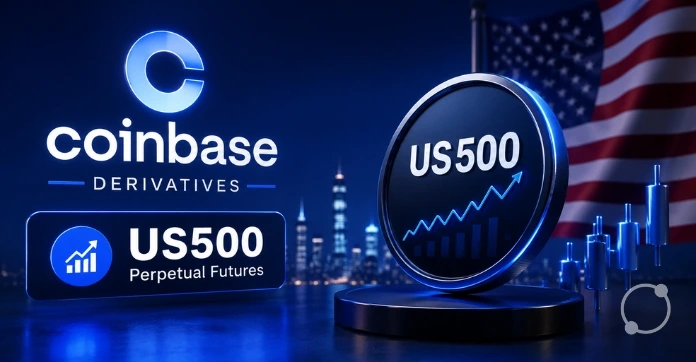
Coinbase just changed the traditional financial boundary. Yesterday the crypto giant announced it is launching “US500” on August 17, 2026. It is a brand-new financial product that lets eligible U.S. investors trade the entire American stock market right from their crypto accounts. Now everyday crypto traders can bet on or against the 500 biggest public companies in America. Coinbase is pulling this off by taking a popular type of crypto contract that never expires and applying it to Wall Street stocks.
Instead of jumping through hoops to cash out during a crypto downfall, investors can now use their existing crypto balances as collateral to seamlessly jump into stable stock baskets. It gives traders a single, unified dashboard to bounce between volatile tokens, changing the rules of how we manage risk.
How Coinbase’s US500 Perpetual Futures Work
This brand-new US500 completely switched the script on how regular investors trade big market indexes. Traditional Wall Street options and futures are notorious for their strict calendar expiration dates. These deadlines force active traders to constantly close out their positions or swallow costly rollover fees every single quarter just to keep their market exposure alive. Coinbase is wiping out that annoying hurdle by using a crypto-native perpetual setup. This means you can hold your broad-market stock positions indefinitely, as long as your account hits the baseline margin requirements. To keep U.S. financial regulators happy, Coinbase structured these contracts to expire after a rolling five-year block, which perfectly satisfies strict domestic laws against infinite perpetuals. Plus, it uses standard crypto funding rate mechanics to make sure the contract price stays locked in lockstep with the actual, real-time spot value of the stock index.
Trade the 500 largest companies, directly on Coinbase.
Introducing our next Equity Index Perp-Style Future – the US500.
Go long or short on the entire US large-cap economy.
Live on August 17 for US traders. pic.twitter.com/vKZ7M4mV3N
— Coinbase 🛡️ (@coinbase) July 30, 2026
On top of that, this rollout brings flexible, two-way leveraged trading directly to the public. One can aim to maximize their capital efficiency of corporate growth or short a major market downswing. This is because the entire ecosystem runs natively on Coinbase’s existing setup, and does not have to deal with capital withdrawals or wait days to off-ramp cash to an old-school stock brokerage just to protect one’s wealth during a crypto crash. Instead, now you can instantly swap your risk straight into blue-chip corporate performance. It lets you use advanced cross-collateralization to treat your digital tokens and stock index positions as one single, unified pool of money, completely rewriting how everyday people protect their portfolios during crazy, high-volatility market jitters.
How Coinbase Is Building Toward an ‘Everything Exchange
Getting this hybrid product into the hands of regular U.S. investors wasn’t easy, Coinbase had to work closely within the Commodity Futures Trading Commission (CFTC) framework. This regulatory green light is a huge deal, showing that federal agencies are finally opening up to crypto tech mixing with traditional markets, which clears a clear, legal path for similar products down the road.
This new stock index isn’t just a random experiment either; it is the foundation of a rapidly growing derivatives lineup. The US500 drops right on the heels of successful launches earlier this summer, where Coinbase rolled out specialized contracts tracking AI, Nasdaq tech giants, defense stocks, and Chinese equities. It also ties into their recent push into 24/7 trading for gold and silver, proving they want to dominate commodities too. By mixing classic stock market indexes with crypto mechanics, Coinbase is parking itself right on the turf of legacy Wall Street giants like the CME Group and fintech apps like Robinhood. This expansion puts them in a prime position to win over a new generation of macro traders who want to manage all their assets under one roof without dealing with old banking barriers.