
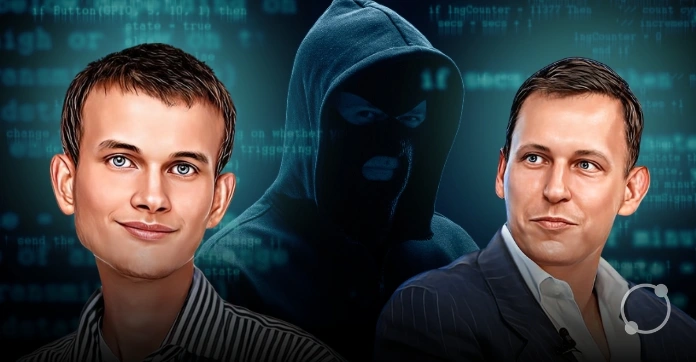
- Buterin says Thiel’s views conflict with Ethereum’s cypherpunk foundations.
- Thiel’s Straussian roots endorse secrecy and surveillance over openness.
- Debate rises on whether Ethereum should ossify like Bitcoin for security.
Ethereum co-founder Vitalik Buterin has drawn fresh battle lines in the crypto world by publicly targeting billionaire investor Peter Thiel. In a blunt post on social media, Buterin said Thiel does not share the cypherpunk values that inspired digital currencies. His comment quickly sparked debate over the role of corporate power in Ethereum and whether the network should eventually freeze its design, much like Bitcoin.
Thiel’s Intellectual Footprint
Thiel’s views trace back decades. While studying at Stanford, he moved in circles influenced by the German-American political thinker Leo Strauss. He co-founded The Stanford Review, a conservative student paper where Strauss’s themes of secrecy and power were common threads.
In a 2007 essay, The Straussian Moment, Thiel argued that espionage and covert coordination among intelligence agencies were necessary for global stability. He wrote that a “pax Americana” could be built not by institutions such as the United Nations but by secret alliances.
That philosophy did not remain in print. It flowed into Thiel’s career. Palantir, which he co-founded, became one of the most essential surveillance firms in the United States. More recently, he has invested in Ethereum-linked companies such as BitMine Immersion Technologies and ETHZilla, giving him significant exposure to the second-largest blockchain.
Privacy vs Power
On the other hand, Buterin’s frustration is rooted in contradiction. Cypherpunks, the movement that shaped Bitcoin and Ethereum, believed in privacy, openness, and resistance to centralized control. They built tools designed to shield individuals from surveillance.
Thiel, by contrast, has long endorsed secrecy, hierarchy, and intelligence-driven systems. His investments in Ethereum, therefore, raise awkward questions: can someone deeply tied to surveillance capitalism be part of a project designed to protect digital freedom?
The Ethereum community has asked that question before. It grows sharper as the network becomes central to stablecoins, tokenized assets, and national digital currencies. The values that guide its leadership will determine how Ethereum develops in an era of rising institutional interest.
Should Ethereum Ossify?
After Buterin’s post, one community member suggested Ethereum should “ossify.” In plain terms, that would mean closing off most protocol changes, following Bitcoin’s model of stability. The argument is straightforward: less change means fewer opportunities for powerful interests to influence the network.
Buterin said he agreed with the principle, but only after Ethereum finishes short-term scaling work and clears technical debt. At that point, he argued, the network should become more conservative.
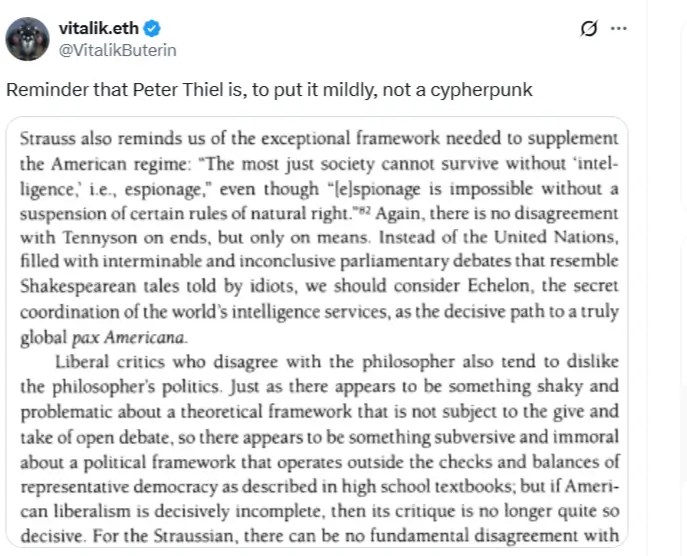
Vitalik Buterin vs. Peter Thiel Heated Debate (Source: X)
However, he resisted the idea of narrowing leadership. Instead of closing ranks, he argued that Ethereum should expand its circle of developers and researchers. In his view, broader participation is a stronger defense against capture than concentrating influence in a small group.
This debate reflects the growing tension in Ethereum’s future. Should it remain flexible, adapting rapidly to new technologies, or should it lock down to protect itself? The answer will affect not only developers but also governments, corporations, and investors building on the network.
Conclusion: Two Visions Collide
The clash between Buterin and Thiel highlights two very different visions. One is rooted in cypherpunk ideals: decentralization, transparency, and individual freedom. The other flows from Straussian thought: secrecy, surveillance, and reliance on elites.
Ethereum sits between them. It is a decentralized platform that increasingly attracts corporate capital. It hosts decentralized applications but also carries billions in value from traditional firms. With tokenized assets expected to reach into the trillions, the stakes are enormous.