What To Know:
- Polymarket ruled a $2.76 million bet on a U.S. invasion of Venezuela as false, arguing that the operation leading to Nicolás Maduro’s capture did not meet its definition of an invasion.
- The decision triggered backlash from users who accused the platform of narrow, after-the-fact interpretations and questioned its credibility amid reports of casualties and political upheaval.
- Separate high-value wagers on Maduro’s removal, including a $436,000 win by an anonymous trader, have intensified scrutiny over contract wording, trust, and possible insider advantage.
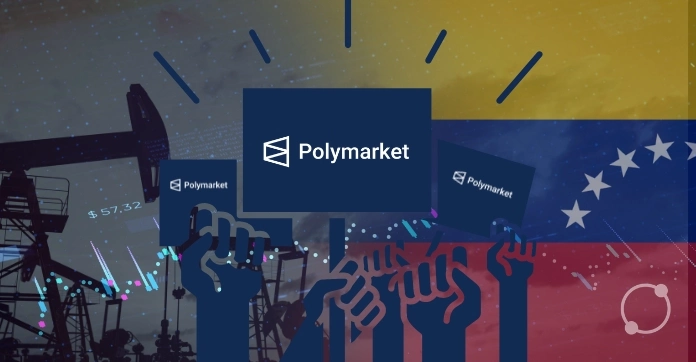
Polymarket, the crypto prediction market, is facing a lot of criticism after refusing to pay out wagers tied to a potential US invasion of Venezuela. The dispute has sparked a debate about how prediction markets interpret reality once real-world events unfold.
Polymarket Bet Sparks Debate on US Invasion of Venezuela
At the center of the controversy is a bet asking whether the United States would invade Venezuela by December 31. Trading volume on the market reached $2.76 million. When U.S. forces carried out a rapid operation that led to the capture of Venezuelan President Nicolás Maduro, many bettors believed the outcome had been decided in their favor, but Polymarket disagreed. The platform resolved the contract as false, stating that the events did not meet its definition of an ‘invasion’.
That decision triggered immediate backlash. In Polymarket’s comment section, users accused the company of applying narrow interpretations after the fact. Several argued that a military incursion resulting in the seizure of a sitting head of state could not reasonably be dismissed on technical grounds. Others described the ruling as arbitrary and detached from the facts on the ground. Some users openly questioned the platform’s credibility, meanwhile others accused it of rewriting terms to avoid large payouts.
Polymarket maintains that its decision followed the contract’s stated criteria. According to the platform, the market would resolve only if U.S. forces began an operation aimed at establishing territorial control. Statements made by U.S. President Donald Trump during negotiations, including remarks about “running” Venezuela, were deemed insufficient. The company also noted that outcomes are determined by a consensus of credible sources rather than public sentiment.
The New York Times cited a Venezuelan official who said the raid resulted in 80 deaths. For critics, that detail shows the disconnect between contract language and lived experience. In their view, the refusal to classify the operation as an invasion reflects how technical definitions can flatten events that involve violence, fear, and political rupture.
The backlash grew after another outcome on the platform drew attention. An anonymous account, created in December 2025, earned roughly $436,000 after correctly predicting that Maduro would be out of power before January 31. The bettor placed four separate positions on regime change, turning a $32,537 wager into a significant payout following Trump’s announcement of the strike on January 3.
That win raised additional concerns. According to reporting by The Wall Street Journal, a mystery trader significantly increased bets on Maduro’s removal just hours before explosions were reported near Caracas. At the time, Polymarket users assigned only an 8 percent chance to Maduro being out of power by the end of January. The timing of the wagers has ignited speculation about possible access to non-public information, though no evidence has been presented publicly.
Together, the disputes have exposed a fragile fault line in prediction markets. These platforms depend on precise language to function and they also rely on trust. Many users opined that when outcomes hinge on how definitions are applied after events unfold, confidence can erode quickly.
Market behavior reflects that shift. Following Polymarket’s clarification, bettors now assign just a 4 percent chance that the U.S. will invade Venezuela by the end of January. That figure had stood at 39 percent before the explanatory note was added. Under the updated interpretation, odds for a U.S. invasion before the end of the year have fallen to 24 percent.
Trading on Venezuela-related outcomes has been heavy. Bets tied to Maduro’s potential ouster alone reached $56.6 million in volume. The scale of those wagers highlights how prediction markets increasingly sit at the intersection of geopolitics, money, and public perception.
Also Read: Skepticism Grows Over Claims Venezuela Holds 600,000 Bitcoin