What To Know:
- Joseph Chee said Solana’s next “super cycle” could begin in Asia, citing the region’s large population and rapid adoption of new technologies.
- Solana’s network activity remains steady, with $6.36 billion in total value locked and over $10 million in daily fees.
- Upcoming upgrades like Alpenglow and ACE aim to boost speed and market structure, positioning Solana for high-frequency and institutional-grade financial applications.
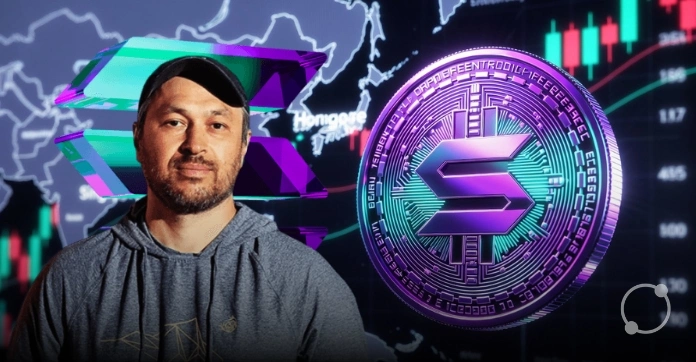
Joseph Chee, CEO of Solana, shared that Asia will ignite the next major growth phase for the Solana ecosystem.
Speaking at Consensus Hong Kong, Chee added that the region’s scale and technological appetite hold advantages. According to Chee, the first wave of mass blockchain adoption will be brought in by users who interact with simple tokenized products through intuitive interfaces. He expects that shift to begin in Asia.
“The first billion people to enter the blockchain world, those who will enter by clicking and using simple tokenized products and various investment targets, will come from here,” Chee said. He cited the region’s vast population and its openness to experimentation. Adoption cycles, he argued, move faster across Asian markets than in many Western economies.
Solana Super Cycle to Begin From Asia
Chee added that from young children using digital tools to elderly citizens participating in online finance, he sees a level of comfort with technology that compresses adoption timelines. That acceleration, he believes, could trigger what he calls a Solana super cycle anchored in Asia.
His remarks come as Solana continues to show steady network activity. Total value locked on the chain stands at $6.366 billion, up 0.4 percent in the past 24 hours. Network fees over the same period reached $10.28 million. SOL is trading at $81.61, and is reflecting a 0.7 percent daily gain amid improving developer and community sentiment.
Notably, Chee’s views extend beyond short-term price performance. The global case for a super cycle depends on infrastructure upgrades and market structure changes that aim to position Solana as a high-speed financial layer for internet-native capital markets.
Former Multicoin Capital co-founder Kyle Samani recently argued that over the next 18 months, Solana’s on-chain microstructure could advance more rapidly than at any previous point in crypto history. Several technical upgrades are aimed at supporting that outlook.
One of the most significant is Alpenglow, which is an upcoming consensus overhaul. The proposal works toward simplifying Solana’s consensus design and cut block finalization time from roughly 12 seconds to between 100 and 150 milliseconds. Legacy elements such as Proof of History and Tower BFT would be replaced with streamlined block propagation and voting systems. The objective is ultra-low latency suitable for high-frequency financial applications.
Another development is Application Control of Execution, or ACE. Traditionally, validators determine transaction ordering. Under ACE, smart contracts and applications would gain authority over ordering logic, settlement rules and priority structures. This change would allow decentralized exchanges and derivatives platforms to design custom trading engines directly on-chain, including anti-MEV mechanisms
In a future Solana upgrade, multiple leaders would be allowed to propose blocks simultaneously, significantly increasing throughput, reducing latency, improving transaction inclusion time, and censorship resistance.
Unlike traditional public AMMs (such as Raydium, Orca’s constant product pools), PropAMMs are privately deployed by professional market makers/institutions, using real-time price oracles to update quotes, actively managing liquidity, and usually not accepting permissionless deposits. They provide extremely low slippage, deeper liquidity, currently accounting for over 60% of Solana DEX trading volume, radically changing the on-chain market structure, making prices closer to CEX levels.
Aggregators like Jupiter, Dflow, etc., aggregate liquidity from multiple sources such as DEXs, AMMs, PropAMMs, etc., to find users the optimal execution path, and offers the lowest slippage and best prices. Lastly, upgrades like conditional liquidity and improvements to SVM and Scheduler are expected to improve on-chain program performance for Solana, and will help provide the foundational support for complex financial applications.
Also Read: ING Germany to Open Retail Bitcoin, Ethereum, Solana ETP Investment