
What To Know:
- Balaji Srinivasan says 2025–2030 will be defined by rebuilding global privacy infrastructure using zero-knowledge proofs, shifting crypto’s core narrative toward minimal-exposure systems.
- He argues ZKYC, ZK DEXs, and ZK smart contracts will reshape financial, identity, and governance processes, attracting top technical talent as privacy becomes foundational.
- The perspective emerges as Bitcoin trades below 100,000, with the market debating whether the downturn reflects routine volatility or signals deeper structural shifts.
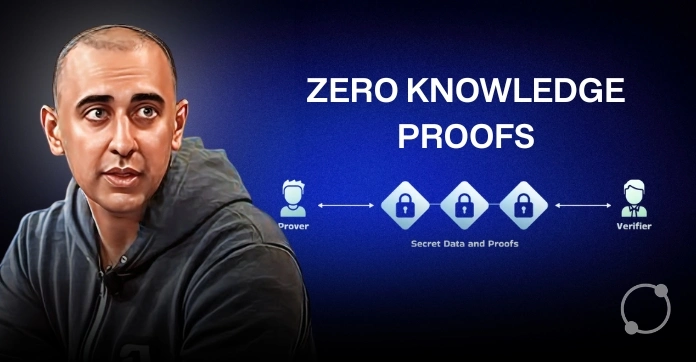
Balaji S, author of “The Network State” and former CTO of Coinbase, argues that 2025–2030 will mark a decisive shift in the crypto era: the reconstruction of global privacy infrastructure. He outlined a three-phase view of industry development, saying the first eight-year cycle after Bitcoin proved digital cash, the second cycle showcased on-chain programmability and scaling, and the next phase will center on privacy built around zero-knowledge proofs.
Balaji S : Zero-knowledge Proofs To Dominate Future Technology
Balaji insists that the dominant narrative for the coming five years will no longer be assets or raw programmability. Instead, he says, the industry must rebuild financial and identity systems so that they expose only the minimum necessary information. Zero-knowledge technologies, he predicts, will underpin ZKYC, ZK decentralized exchanges, ZK smart contracts and an array of privacy-preserving tools that place data minimization at the core of design.
The three eras of crypto.
Proof of work: 2009-2017
Programmability: 2017-2025
Privacy: 2025-203Xpic.twitter.com/YIpJN2OMZo— Balaji (@balajis) November 13, 2025
The argument arrives as industry participants wrestle with market turbulence and structural questions. Bitcoin’s recent pullback below the 100,000 mark has triggered debate among investors and developers, but Balaji frames such price movements as peripheral to a deeper technical continuum. He points to the mathematical depth of zero-knowledge systems and likens the field’s technical challenge to that of artificial intelligence, suggesting that ZK work will attract top research talent and critical capital.
His vision is wide-ranging. Payment rails, identity verification, and on-chain governance could all be reimagined to reveal only what is strictly required for a transaction or an approval. That approach would preserve compliance where needed while saving personal and business data from broad public exposure. If realized at scale, this shift would reshape how regulators, institutions and users interact with blockchain networks.
Balaji also connects privacy to emergent social and political ideas, including on-chain identity systems and the concept of compact, digitally-native communities. He believes that ENS-style naming systems, social namespaces and other identity primitives will ferment alongside privacy tooling, enabling new forms of association that protect individual privacy while supporting verifiable reputation.
Critics caution that deploying privacy infrastructure at scale raises complex regulatory and technical tradeoffs. Privacy-preserving tools can complicate anti-money laundering controls and strain compliance regimes if regulators do not adapt. Technical hurdles remain, including proving protocols are secure and ensuring that ZK systems can operate efficiently across high-throughput networks.
Still, proponents say progress on those fronts is accelerating. Advances in proving systems, verification layers and developer tooling have reduced friction. Venture capital and institutional research teams are increasingly funding ZK projects, suggesting commercial incentives are aligning with cryptographic innovation.
If Balaji’s timeline proves accurate, the next half-decade may see privacy move from niche research to foundational infrastructure. That would alter priorities for builders: wallets would embed selective disclosure; exchanges would integrate privacy-preserving settlement; and identity frameworks would shift from broad public attestations to minimal, auditable claims.
Policy makers and industry leaders will need to reconcile competing demands, privacy for users, transparency for oversight, and scalability for mainstream adoption. The balance they strike will decide whether privacy tools become enablers of broader market growth or points of contention that slow integration.
Balaji’s prescription places privacy at the center of crypto’s roadmap. It is a provocative, focused stance that reframes the debate about what comes next.
When it comes to the market stance, Bitcoin has slipped below the $100,000 mark. Bitcoin’s prices opened near $97,007.28 after a decent 0.1% decline over 24 hours. This dip was instrumental in extending losses that accelerated through October when the crypto fell 13.8 percent. The pullback has led to an outpouring of commentary from crypto market veterans, whose reactions convey caution and conviction.
Some observers call the move as a routine correction within a longer-term uptrend. Binance founder Changpeng Zhao wrote on X, “Every time there’s a pullback, someone always thinks it’s the end of the world, but time keeps moving forward.” That view captures a common market refrain: volatility is not a verdict.
Also Read: Alleged BTX Capital Founder Linked to Hyperliquid Token Manipulation