

- Tenev calls tokenization a freight train set to transform finance worldwide.
- Stablecoins and stock tokens are seen as gateways for global U.S. market access.
- Robinhood eyes tokenized real estate and prediction markets as next frontiers.
At the Token2049 conference in Singapore, Robinhood CEO Vlad Tenev described tokenization as an unstoppable force shaping global finance. He explained that the shift toward digital assets is not a passing trend but an infrastructure overhaul that will define how capital flows in the coming decade.
According to him, tokenization resembles a freight train, gathering speed and set to transform every corner of the financial system. He estimated that most major markets may establish tokenization frameworks within five years, though full global adoption could take longer.
“I think tokenization is like a freight train,” Tenev noted. “It can’t be stopped, and eventually it’s going to eat the entire financial system.”
In his outlook, a complete shift could stretch beyond a decade. He noted that the U.S. will likely lag behind Europe and Asia because its financial system functions well enough to resist urgency. Tenev compared the situation to transportation.
He said that countries like Japan invested in high-speed trains, while the U.S. maintained slower rail systems because they were adequate. In the same way, the American system already enables reliable market access, leaving fewer incentives for rapid change.
Stablecoins and Stock Tokens as Global Gateways
Tenev highlighted stablecoins as the first stage of tokenization. Dollar-pegged coins, he explained, are increasingly popular because they strengthen the global role of the U.S. dollar. Hence, stablecoins serve as a model for how tokenized assets could expand, especially outside America.
Consequently, he argued that tokenized stocks will become the default path for foreign investors seeking U.S. exposure. Robinhood already launched stock tokens in Europe, offering investors continuous access to American equities.
Tenev framed this move as a parallel to stablecoins, which gave digital access to dollars. He suggested that tokenized equities could redefine global participation in U.S. markets. Besides, he described the convergence of crypto and traditional finance as inevitable.
For years, the two ecosystems operated in isolation, yet blockchain technology’s efficiency will eventually merge them. He predicted that the boundaries between digital assets and traditional securities will disappear, replaced by a unified system of 24/7 global trading.
Real Estate Joins the Tokenization Wave
Robinhood’s vision extends beyond stocks. Tenev revealed that the company is preparing to tokenize real estate, treating it as the next major frontier. He explained that the process mirrors how private companies like OpenAI or SpaceX could be tokenized: assets are placed into structured entities, and tokens are issued against them.
Moreover, he noted that the technical aspects of tokenizing real estate are straightforward, while the real challenges arise from regulation. Europe is moving forward at a faster pace, while the U.S. remains cautious. Despite legal debates, he views real estate as a logical extension of Robinhood’s tokenization strategy.
He acknowledged controversies, including OpenAI’s objection to tokenizing its private shares, but dismissed them as symptoms of regulatory delays. Once frameworks evolve, he expects tokenization to encompass a broad range of assets, from property to company equity, which can be traded with the same ease as digital currencies.
Prediction Markets Rising Beyond Traditional Boundaries
Beyond tokenization, Robinhood is also investing in prediction markets. Since their launch in late 2024, more than four billion event contracts have been traded. These include markets tied to elections, sports, cultural events, and emerging technologies.
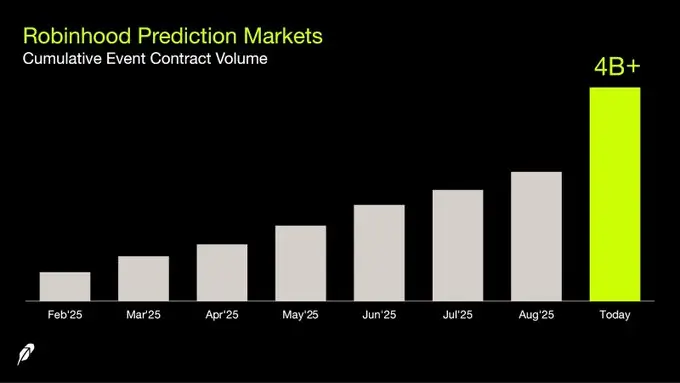
Robinhood Prediction Markets (Source: X)
Significantly, Tenev emphasized that prediction markets extend well beyond politics. Sports, particularly football, now account for heavy trading volumes. Culture and AI topics are also attracting interest. Many participants use these markets for information, not just speculation, creating parallels with financial products and even news platforms.
However, prediction markets face criticism for resembling gambling. Tenev countered that skepticism always follows new innovations. He argued that these products combine traits of futures contracts, sports betting, and active trading, while also serving as informational tools.
Additionally, Robinhood is preparing to expand its prediction markets internationally. Talks with regulators, including the U.K.’s Financial Conduct Authority, are already underway. Rules vary widely, with prediction markets treated as futures in the U.S. but as gambling in many other countries. Tenev stressed that Robinhood is adapting its platform to fit these diverse global frameworks.