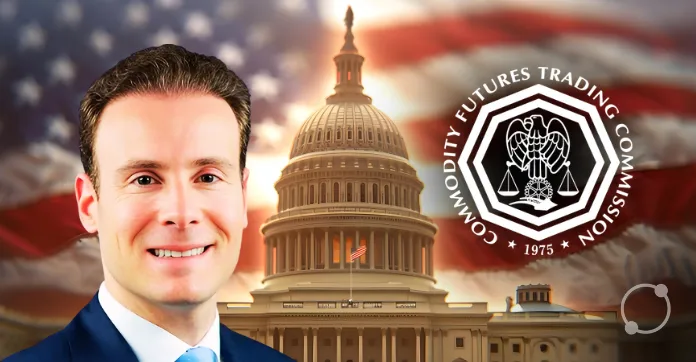
The White House is nearing the nomination of Mike Selig, (Chief Legal Advisor to the SEC Crypto Task Force) as the next Chair of the Commodity Futures Trading Commission (CFTC). With the nomination, officials are reportedly reviewing candidates for commissioner positions.
White House Expected to Nominate Mike Selig as Next CFTC Chair
At present, the CFTC is being led by Acting Chair Caroline Pham, who has served in an interim capacity since September 3. Selig, a former assistant to a CFTC judge, previously worked on crypto policy at Perkins Coie and later at Willkie Farr & Gallagher.
🚨🗞️NEW: White House Close to Announcing Selig as CFTC Chair Nominee
It’s also said to be vetting potential commissioners as it looks to rebuild the 5-member commission.
PLUS crypto rebounds after historic sell-off & what to keep an 👀 on this week. ⬇️https://t.co/RjOnvKKXWP
— Eleanor Terrett (@EleanorTerrett) October 13, 2025
Industry figures have expressed strong support for Selig’s potential appointment, describing him as a pragmatic and forward-looking choice for the changing crypto.
“Now leading the SEC’s Crypto Task Force, he’s delivered the most effective regulatory work we’ve seen from any major regulator,” said Evan Weiss, COO at Alluvial and a former corporate attorney. “If we want America to be the crypto capital of the world, Mike is the right choice to chair the CFTC.”
The endorsement comes as the White House looks to stabilize leadership within the CFTC, which has faced staffing shortages and internal uncertainty. While the agency traditionally has one chair and four commissioners, it has operated for months under Pham’s sole leadership.
Selig’s nomination follows the collapse of an earlier candidate’s run , Brian Quintenz, the former head of policy at Andreessen Horowitz’s crypto arm. Quintenz, who had also received significant industry backing, saw his nomination derailed by internal disputes involving the Winklevoss twins, co-founders of Gemini.
According to reports, the twins opposed his nomination due to a long-running CFTC investigation into Gemini, which concluded earlier this year with a $5 million consent order. Quintenz publicly released screenshots of messages from the twins, who urged him to prioritize “cultural reform” within the agency and align with the administration’s agenda. Quintenz responded that any such action would fall under the purview of a “fully confirmed chair,” a statement that ultimately did little to save his nomination.
This latest development symboliozes the increasingly political nature of crypto regulation in Washington. As debates over market oversight get intense, the CFTC has emerged as a key agency in defining the industry’s future. A proposed market structure bill moving through Congress seeks to give the CFTC greater authority over digital assets, which is quite contrary to SEC’s aggressive enforcement-led approach.
Selig’s background suggests he could favor a more collaborative regulatory model. A longtime advocate for innovation-friendly policies, he has criticized what he calls “regulation by enforcement” under former SEC Chair Gary Gensler. “The election is a week away, BTC just broke $71k, and SEC Chair Gensler will soon be cleaning out his office,” Selig wrote on X last October. “It’s time for the SEC to institute a hard fork in its approach to regulating crypto and welcome the builders back to America.”
In March, Selig was appointed as General Counsel of the SEC’s 14-person Crypto Task Force, a team formed to draft specialized frameworks for digital asset regulation. He also served as Senior Adviser to SEC Chair Paul Atkins, who recently announced Project Crypto, a deregulatory initiative aimed at integrating blockchain-based transparency into equities markets.
Notably, Cameron Winklevoss praised Project Crypto as “one of the most groundbreaking things I’ve read in a very, very long time” during a New York crypto conference last month, a rare moment of alignment between the industry and Washington policymakers.
If confirmed, Selig would inherit an agency central to defining the next phase of crypto governance in the US.
Also Read: Garrett Jin Denies $4.23B Insider Trading & Trump Ties